As Indonesia eyes electric conversion of 120 million motorcycles in 4 years, experts warn of potential bumps ahead
President Prabowo Subianto's programme promises long-term savings on fuel imports and subsidies, but limited infrastructure and low consumer confidence may hinder ambition, say analysts.

This audio is generated by an AI tool.


JAKARTA: Riding a motorcycle in Jakarta’s rush hour traffic can be an assault on the senses: deafening engines roaring on all sides while thick, nauseating fumes hang heavy in the air.
At traffic junctions of gridlocked streets, bikes often cram so tightly together that a brush with a searing exhaust pipe can sometimes burn another rider’s skin.
But President Prabowo Subianto has a vision to make this daily chaos a thing of the past. Petrol-powered motorcycles, a dominant mode of transport in the archipelago, could be converted into electric ones as part of a sweeping push towards energy independence.
“The whole plan is to convert all of our motorcycles to electric,” Prabowo said in a video uploaded to his YouTube channel on Mar 25. He added that other vehicles, including cars, trucks and tractors must also run on electric power.





“So later, wealthy people who own Lamborghinis or Ferraris can go ahead and use petrol. They’ll just have to pay the global price.”
The remarks came as the world is reeling from the United States-Israel war on Iran which has caused global oil prices to soar by between 50 per cent and 100 per cent of what they were before the conflict.
The rising prices prompted Prabowo to form a government task force on energy transition on Mar 5 with the goal of making Indonesia less reliant on fuel imports and becoming energy self-sufficient.
Energy and Mineral Resources Minister Bahlil Lahadalia is leading the task force.
“Our 120 million motorcycles that run on petrol, we will try to gradually convert them to electric motorcycles,” Bahlil said that day.
“The president earlier conveyed that the maximum timeframe is three to four years, or even faster if possible.”
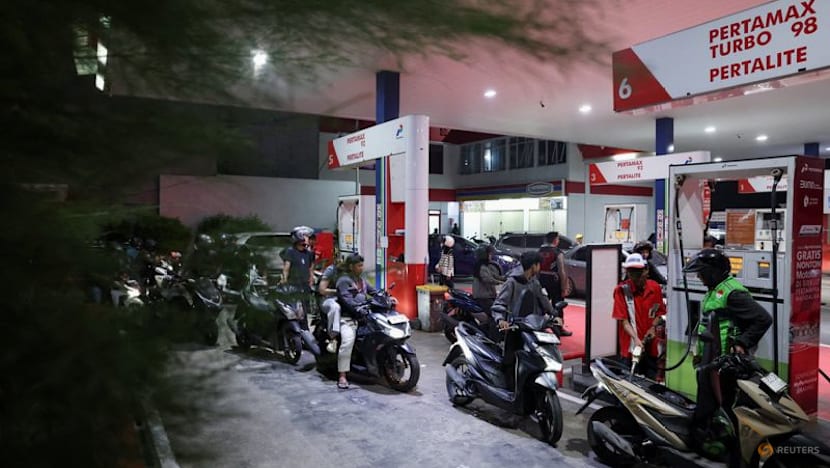
According to the Indonesian Ministry of Energy and Mineral Resources, Indonesia imports around 1 million barrels of oil per day. Between 20 per cent and 25 per cent passes through the Strait of Hormuz which has been closed since the conflict began in late February.
“For a country as big as ours to be independent, to survive, we must be self-sufficient particularly in the field of energy,” Prabowo said on Apr 9.
“One way is through electrification … so we don’t use too much fossil fuel.”
The president said his administration plans to build 100 gigawatts worth of solar farms and shut down 13 diesel power plants over the next two years, which he said will cut Indonesia’s fuel imports by 200,000 barrels per day.
But his ultimate goal is to stop importing fuel altogether. To get there, Indonesia plans to convert 120 million internal combustion engine motorcycles into electric ones in three to four years.
The government is also preparing a regulatory framework to one day require all motorcycles sold in Indonesia be electric, thereby compelling owners of existing internal combustion engine bikes to convert.
Experts said the motorcycle conversion target and deadline is highly ambitious, pointing to the technical hurdles the government must overcome before conversions can be carried out at such a scale.
“The number of authorised workshops is no more than 50, and even those are concentrated in Greater Jakarta,” Fabby Tumiwa, executive director of Jakarta-based think tank Institute for Essential Services Reform (IESR), told CNA.
Meanwhile, electric vehicle (EV) adoption in Indonesia is still low. According to data from the Ministry of Transportation, only 123,000 of the country’s 20 million cars and 236,000 of its 139 million motorcycles are electric.
“Many are still sceptical about the practicality and reliability of EVs. Even with government subsidies, not everyone will be willing to convert their motorcycles,” Fahmy Radhi, an economist from Indonesia’s Gadjah Mada University, told CNA.
“This is ultimately about changing consumer thinking and behaviour, not just a technical issue.”

KEY LESSONS FROM PAST PROGRAMMES
Prabowo’s predecessor, Joko “Jokowi” Widodo, also rolled out a similar motorcycle conversion programme in 2023 and 2024, offering subsidies of between 7 million and 10 million rupiah (US$408 to US$583) for conversion kits, which included batteries, motors and other components.
Without subsidies, conversions typically cost between 15 million and 17 million rupiah.
Motorcycles were chosen because the cost of electrification is considerably less than for cars, where electrification typically costs between 100 million and 150 million rupiah.
But the motorcycle conversion programme failed to gain traction.
The Ministry of Energy initially targeted 50,000 conversions in 2023 and 150,000 in 2024. In reality, just 145 units were converted in 2023 and 1,615 in 2024, CNN Indonesia cited a senior ministry official as saying in December 2024.
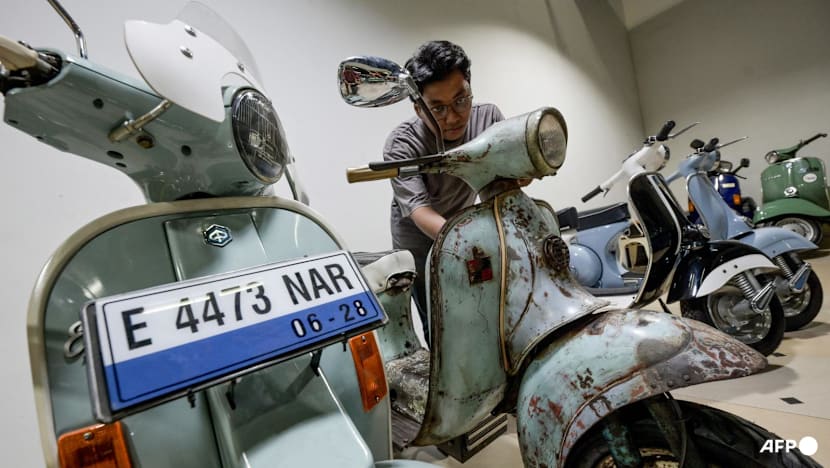
Bebin Djuana, a retired automotive executive and author on Indonesia’s car industry, said there are key lessons from the earlier attempt.
“There were many supporting factors that were not yet in place,” he said.
“Each vehicle model is different - you can’t apply a one-size-fits-all conversion. A model determines what motor to use, what battery, and where to place them. We need trained workers to handle conversions, but where is the training?”
Skilled manpower remains scarce. By the end of 2024, only 39 workshops had received certification to participate in the government’s conversion programme - and most were small operators.
“If one workshop can handle about 1,000 units a year, we would need around 20,000 conversion workshops nationwide to reach the 20 (million) to 30 million conversions per year the Prabowo government is aiming for,” said Fabby of IESR.
But perhaps the biggest hurdle that remains is consumer confidence.
“People are interested because they can save on fuel. But consumers don’t just think about efficiency, they think about reliability,” said Putra Adhiguna, managing director of think-tank Energy Shift Institute.
Beyond established players like Japan’s Honda and Indonesia’s Viar, much of the electric motorcycle market is dominated by relatively new entrants such as Gesits and Smoot, both of which launched their first models in 2021.
Then there is Polytron, a well-known Indonesian electronics brand which entered the motorcycle market in 2018 and introduced its first model three years later.
“Public confidence is not there yet, even for factory-made electric motorcycles. You can imagine how much lower it is for converted motorcycles using kits produced by lesser-known companies and installed by small workshops,” said Putra.
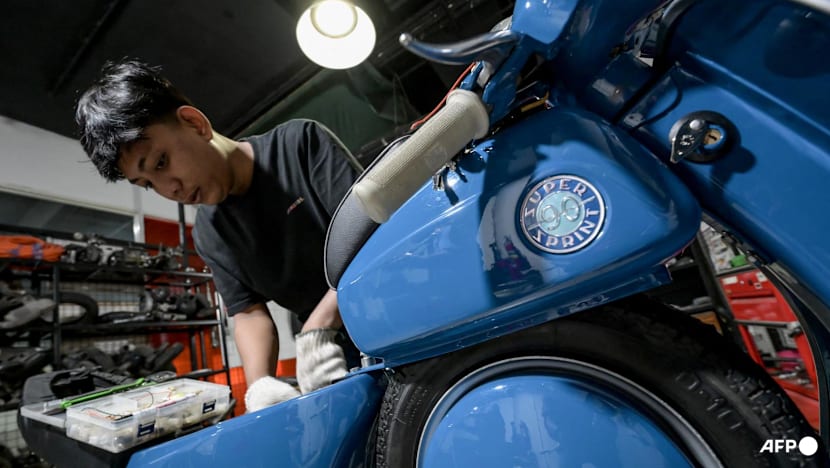
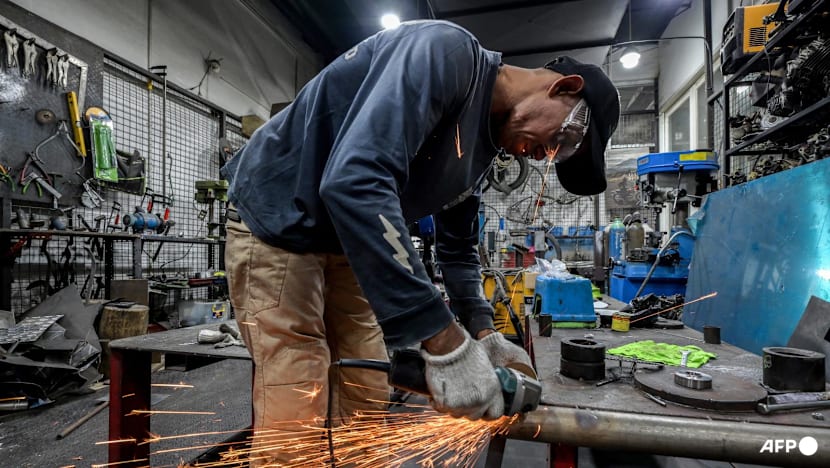
The conversion process involves removing a motorcycle’s fuel tank and engine and replacing it with a battery pack and an electric motor.
According to media reports, an experienced team of mechanics can take between 45 minutes and two hours to convert one bike from start to finish.
Today, there are several Indonesian companies such as Bintang Racing Team, Elders Garage and Spora EV which offer their own conversion kits using in-house motors along with Chinese or South Korean made batteries.
Most workshops however use third-party motors from a plethora of small American and Chinese companies.
DRIVING DOWN A NEW ROADMAP
The new task force is currently drafting a roadmap to accelerate EV adoption, with some key differences from the earlier attempt.
Bahlil said the government will roll out subsidies and other incentives to boost public participation, adding that motorcycle owners are likely to pay less than under the 2023 to 2024 scheme.
“Now there are cheaper technologies available, so it may cost (motorcycle owners) around 5 (million) to 6 million rupiah (to convert their bikes). It’s getting more affordable over time,” Bahlil said on Mar 5.
Meanwhile, Industry Minister Agus Gumiwang Kartasasmita said the government is preparing a regulatory framework that could eventually phase out internal combustion engine motorcycles, including a mandate requiring all motorcycles sold in Indonesia to be electric.
“The government is preparing regulations requiring existing electric motorcycle producers in Indonesia to ramp up production capacity, as we aim for all domestically sold motorcycles to be electric,” he said on Apr 9, as quoted by the Jakarta Globe.
“Conventional vehicle production does not need to stop, but it will be directed towards export markets such as Africa, the Middle East and South America.”
Indonesian officials have not disclosed how much funding Jakarta will allocate for the electric conversion programme.
However, should the government decide to provide the same subsidy amount of up to 10 million rupiah per bike, then the programme could cost taxpayers 1,200 trillion rupiah or around US$70 billion dollars.
Experts said it remains unclear whether the hefty price tag will be worth it.
In 2025, Indonesia spent 26.7 trillion rupiah on fuel subsidies. But the country also subsidises electricity for around 40 million households, with spending reaching 90.2 trillion rupiah last year.
The environmental benefits are also uncertain.
According to the International Energy Agency, fossil fuel combustion in Indonesia emitted 659 million tonnes of carbon dioxide in 2023. Around 50 per cent of those emissions came from electricity generation, while the transportation sector accounted for about 22 per cent.
“Electric vehicles themselves produce zero emissions, but 56 per cent of Indonesia’s electricity is still generated from coal,” Fahmy of Gadjah Mada University said.


STARTING SMALL TO SCALE UP
While analysts whom CNA spoke to agreed the programme is a step in the right direction, they said its timeline and scale need to be realistic.
“Conversion is a long-term programme. It cannot be rolled out immediately without obstacles,” said Fahmy.
“These programmes are not suited to addressing short-term problems like rising fuel prices.”
Experts said Indonesia should adopt a more gradual approach, starting with specific segments such as delivery and ride-hailing drivers.
“It’s better to start in a few major cities rather than going nationwide immediately,” said Putra of the Energy Shift Institute. “The wider the rollout, the more problems will emerge.”
Starting small would also give conversion workshops time to recruit and train workers, build capacity and scale up operations.
At the same time, the government needs to secure cleaner sources of electricity and expand charging and battery-swapping infrastructure, experts said.
Currently, electric vehicle charging stations are mostly located only in urban areas.
Iwa Garniwa, a renewable energy expert from the University of Indonesia, said the government could also prioritise older motorcycles, which tend to produce higher emissions.
“Don’t focus on the numbers first. Focus on the spirit of the programme and prioritise which segments should be converted,” he told CNA.
Iwa added that rising fuel prices are already prompting people to consider switching to electric vehicles, which could in turn encourage more businesses to participate in the scheme.
“People are starting to show interest, and the government should capitalise on this by making the transition as smooth as possible,” he said.
“This is a real opportunity to reduce fuel subsidies and lower carbon emissions.”