Indonesia to probe taxi operator Green SM after deadly Bekasi train crash
A Green SM electric taxi was involved in the fatal train collision near Jakarta on Monday night (Apr 27) that killed 16 people.
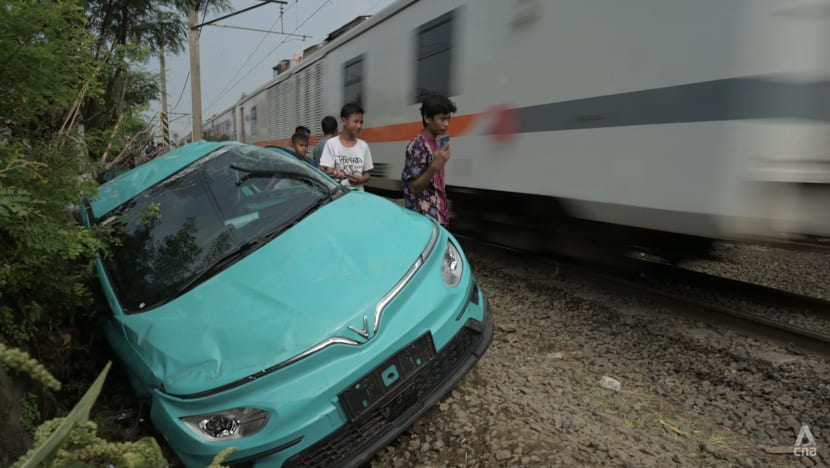
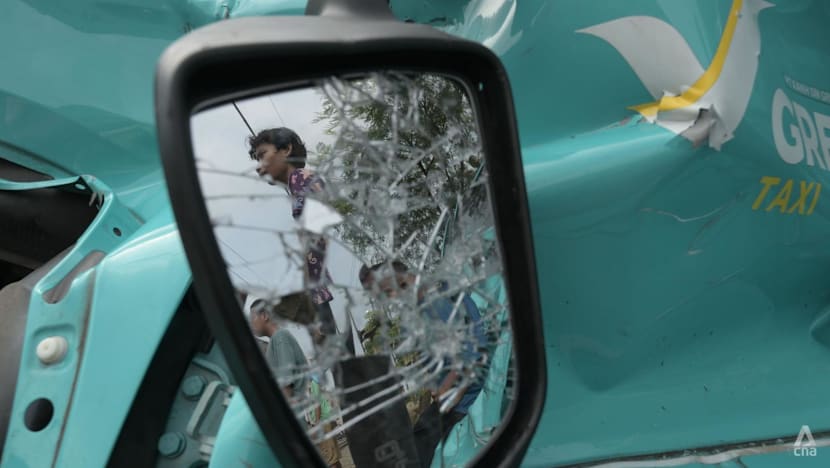
The electric taxi believed to have triggered a fatal train accident in Bekasi, near Jakarta, on Monday, Apr 27, 2026. (Photo: CNA/Wisnu Agung Prasetyo)
JAKARTA: Indonesia’s transport ministry has formed a special team to investigate the involvement of a Green SM electric taxi in a train collision that killed 16 people near Jakarta on Monday night (Apr 27).
The taxi was crossing the tracks along Jalan Ampera - a narrow potholed road in Jakarta’s neighbouring city of Bekasi - when it broke down and was hit by a train approaching the nearby East Bekasi Station.
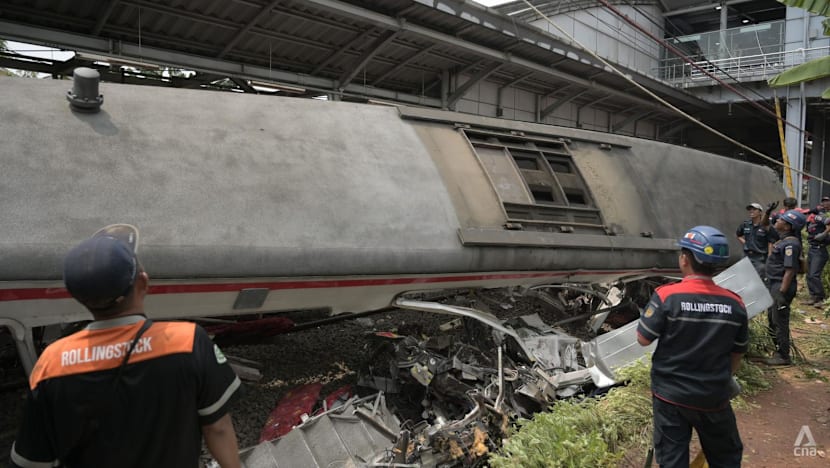
Train operator Kereta Api Indonesia (KAI) instructed a second commuter train travelling in the opposite direction to remain at East Bekasi Station, but a third train travelling from Jakarta to Surabaya in East Java crashed into the stationary commuter train, crushing passengers who were in a packed all-female carriage at the rear.
The probe will examine key aspects of the taxi operator’s operations, Director-General of Land Transport Aan Suhanan said on Tuesday. The operator, Green SM Indonesia, is the local branch of Vietnam-based Green SM, which runs a fleet of VinFast electric vehicles.
“We have formed this special team to look into the involvement of the Xanh SM taxi, including its licensing, administrative compliance, adherence to safety standards and compliance with public transport operational regulations,” Aan said, as quoted by news outlet Kompas, using Green SM’s alternative name.
“Our principle is clear, public safety is the top priority and any potential violations will be dealt with in accordance with regulations.”





Indonesia’s transport ministry also conducted a spot inspection of Green SM’s taxi fleet in Bekasi and summoned the company’s management to its headquarters on Tuesday for further clarification.
Local media reported that the vehicle is officially registered, holds a valid monitoring card until Oct 28, 2026 and operates as a regular taxi in the Greater Jakarta area.
Green SM also holds a Public Transport Company Safety Management System certificate valid for five years.
“The ministry will continue its investigations to ensure all requirements have been met. We will also audit the safety management elements that public transport companies are required to comply with,” Aan of the transport ministry said.
“We will review how safety management standards are implemented on the ground, including the company’s responsibilities in ensuring that vehicles, drivers and operational systems meet safety requirements.”
The ministry said sanctions could be imposed if violations are found. Sanctions could take the form of warning letters, temporary suspension or revocation of operating licenses, depending on the severity of the violations.
Separately, Cabinet Secretary Teddy Indra Wijaya said the probe into Green SM is part of broader government efforts to improve transport safety.
In response to the incident, Green SM said it is cooperating with the authorities and supporting the investigation.
“Safety remains our top priority. We are committed to maintaining high safety standards through our operational systems, supervision and continuous service improvements,” the company said on Tuesday.
The company’s initial response on social media had drawn public criticism as it did not immediately include an apology or condolences, and had disabled comments.
Green SM issued a statement expressing its condolences several hours later.
“We extend our deepest sympathies and condolences to the families and loved ones of the victims. We are deeply concerned about this incident and hope all those affected will recover and remain safe,” the company said.
In the wake of the accident, experts and advocacy groups have called for a thorough investigation into the circumstances that led to the tragedy as well as heightened safety measures. President Prabowo Subianto has also pledged to phase out level crossings nationwide.
Experts earlier told CNA that there should be separate tracks for express long-distance trains and commuter trains, and sufficient funds allocated to build overpasses to replace the level crossings.