



Indian trade body urges retaliatory tariffs on US goods, warns 500,000 jobs at risk
More than US$48 billion worth of Indian exports could be affected by the proposed US tariffs, with the textile, gems and jewellery, auto components and seafood industries among the hardest hit, a trade body warns.
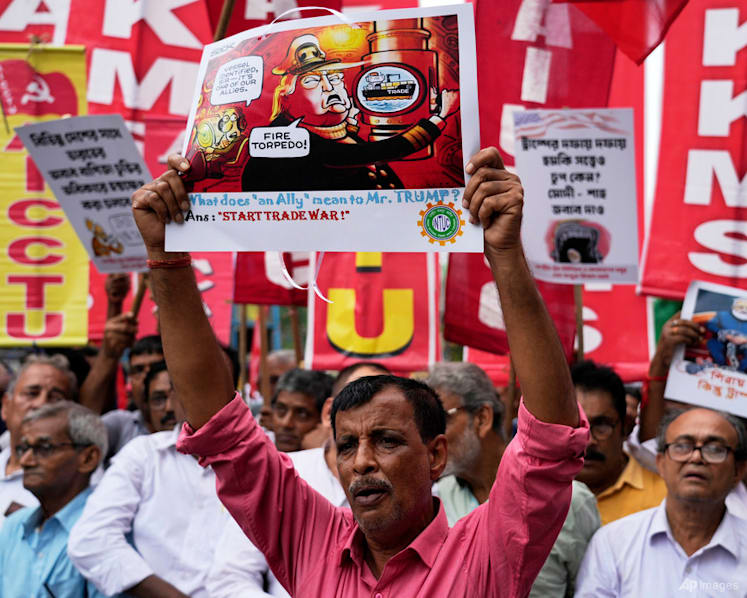
Activists of different trade unions and farmer's organisations walk towards the American Consulate in a protest rally against the US President Donald Trump on trade tariffs in Kolkata, India, on Aug 13, 2025. (Photo: AP/Bikas Das)

This audio is generated by an AI tool.


BENGALURU: An Indian trade body has urged New Delhi to impose retaliatory tariffs of 25 per cent on American goods, warning that Washington's latest tariff proposals could put 500,000 jobs at risk and affect more than US$48 billion worth of Indian exports.
Brijesh Goyal, chairman of the Delhi-based Chamber of Trade and Industry (CTI), said in a statement shared with CNA on Thursday (Nov 26) that the textile, leather, gems and jewellery, auto components and seafood industries could be severely affected.
The US Trade Representative (USTR) proposed tariffs of up to 25 per cent on Indian goods over allegations that India produces more goods than its market needs, potentially falling to 17 per cent if New Delhi reaches a trade deal with Washington.
India's Commerce Ministry said it was reviewing the US proposal, reiterating that the country had no structural excess manufacturing capacity in any sector and that trade-related concerns should be addressed through ongoing bilateral negotiations.
Before the announcement, Indian goods covered by an earlier US Section 301 measure faced an additional 10 per cent tariff, imposed in July following a separate investigation concerning forced labour, according to India's Commerce Ministry.






The USTR said the proposed tariffs would account for existing Section 301 duties rather than being added on top of them, meaning Indian goods already subject to a 10 per cent additional tariff could face a rate of up to 25 per cent, rather than 35 per cent.
Certain products, including smartphones, pharmaceuticals, semiconductors, metals, vehicles and aircraft parts, are exempt from the proposed tariffs, although existing duties may still apply.
Goyal said CTI had written to Prime Minister Narendra Modi urging him to impose matching tariffs on goods from the United States, pointing to imports of American minerals, gems and jewellery, machinery, aircraft equipment, electronics, plastics, chemicals, and iron and steel.
“India should reduce its dependence on America for all these things and look for options in other countries,” Goyal said.
Meanwhile, Chandrima Chatterjee, secretary general of the Confederation of Indian Textile Industry (CITI), warned that frequent tariff changes were creating uncertainty for exporters and overseas buyers, disrupting trade negotiations, pricing and order commitments.

Rohit Kumar, chairman of the India Trade Council, echoed these concerns, and told CNA that prolonged tariff uncertainty was already affecting sourcing decisions by American buyers.
“US buyers are nervous. They are shifting manufacturing to the US as much as possible,” he said, adding that while such a shift was not feasible for many products, it remained a long-term goal.
Kumar argued that other Asian manufacturing hubs, including Vietnam and Bangladesh, were not necessarily safer alternatives to India, as they could face similar tariff actions.
Ajay Srivastava, founder of Indian trade policy think tank Global Trade Research Initiative (GTRI), described the USTR's proposed tariffs as “a deliberate bait to extract one-sided concessions” in the trade negotiations and urged India to reject such a deal.
The proposed US tariffs have not yet taken effect, with Washington seeking public comments until Jan 5, 2027, ahead of hearings scheduled to begin on Jan 25, according to the USTR.