Indian police say 47 Maoist rebels surrender
Police in the southern state of Telangana said that 47 Maoist members “chose to join the mainstream”, adding that “almost all remaining underground key leaders... have now been neutralised”.
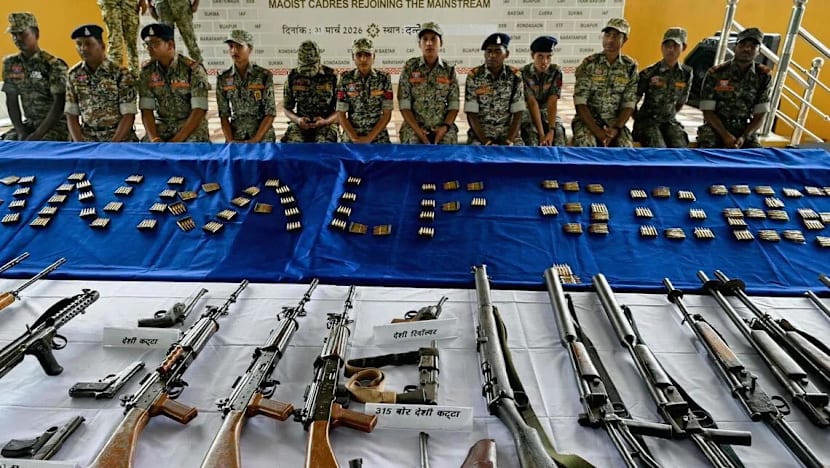
Weapons seized from Maoist rebels and fighters upon their surrender are displayed at a police facility in Dantewada in Chhattisgarh state's Bastar division. (Photo: AFP)
NEW DELHI: The Indian police said on Saturday (Apr 25) that 47 Maoist rebels have surrendered, nearly a month after the country was declared free of the decades-long insurgency.
India has pushed a campaign for the past two years against the last remnants of the Naxalite rebellion, named after a village in the Himalayan foothills where the Maoist-inspired insurgency began nearly six decades ago.
The police in the southern state of Telangana said that 47 Maoist members “chose to join the mainstream”, adding that “almost all remaining underground key leaders... have now been neutralised”.
India’s Home Minister Amit Shah declared the country Naxal-free on Mar 30.





More than 12,000 rebels, soldiers and civilians died in the conflict since a handful of villagers rose up against their feudal lords in 1967.
At its peak in the mid-2000s, the rebellion operated in swathes of the country with an estimated 15,000 to 20,000 fighters, but it was drastically weakened in recent years.
The police have appealed to remaining members to also lay down their arms.
The authorities have said that surrendered rebels are being given new civilian identities through vocational training and rehabilitation programmes.
The 47 surrendered Maoists will be paid a total of US$159,000 as part of their rehabilitation, roughly US$3,400 each.
But a daunting task remains of clearing hundreds of crude landmines planted by the rebels along forest tracks.
In the past, the Maoists would say they were fighting for the rights of marginalised indigenous people in the mineral-rich forests of central India.