Oil prices dip, Asian stocks rise on lingering Iran peace hopes
Investors remained largely upbeat that the US and Iran will eventually come to a deal that will reopen the strategic Strait of Hormuz.
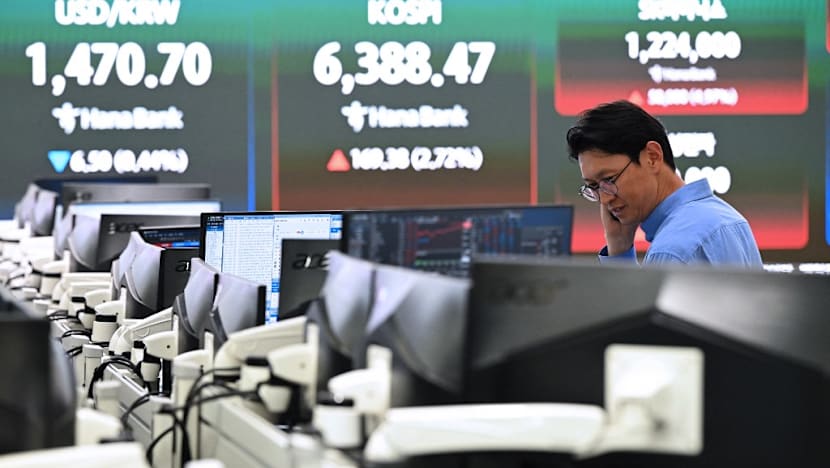
A currency dealer monitors exchange rates as a screen shows South Korea's benchmark stock index (KOSPI) and the Korean won/USD exchange rate in a foreign exchange dealing room at the Hana Bank headquarters in Seoul on Apr 21, 2026. (Photo: AFP/Jung Yeon-je_
HONG KONG: Oil prices fell on Tuesday (Apr 21) while stocks rose on lingering hopes for a deal to end the US-Iran war and reopen the Strait of Hormuz, even as Tehran said it had not decided whether to attend peace talks.
With the end of a two-week ceasefire approaching, the White House said Vice President JD Vance was ready to return to Pakistan for fresh negotiations to end a conflict that has sent crude soaring and revived inflation fears.
However, the Islamic Republic's position remained uncertain as it accused Washington of violating their fragile truce through its blockade of the country's ports and seizure of a ship.
Still, investors remained largely upbeat that the two sides will eventually come to a deal that will reopen the strategic strait.
US benchmark crude West Texas Intermediate and Brent both fell more than 1 per cent on Tuesday.
Seoul led equity market gains thanks to a resumption of the tech rally that had pushed the Kospi to multiple records before the war, climbing 2.7 per cent to hit a fresh record high.
Tokyo and Taipei were also well up, with Hong Kong, Shanghai, Singapore, Wellington, Mumbai and Bangkok also advancing.
Asia had opened "with a gentle lean into risk as signs Iran may join talks with the US offer a pathway, however narrow, toward easing tensions ahead of the ceasefire deadline", wrote SPI Asset Management's Stephen Innes.
"Trump's remark that a ceasefire extension is 'highly unlikely' if no deal is reached has effectively put a clock on the market.
"However, traders recognise the playbook. Hard deadlines and firm rhetoric often soften as negotiations evolve, but the presence of a timeline still sharpens positioning and raises the stakes around each headline."
Michael Brown at Pepperstone said it was "now in the interests of both sides - the US as public support for the war dwindles, and Iran, given the primary objective simply of 'survival' - to bring the conflict to an end".
"Viewed through that lens, all the punchy rhetoric and headline noise that we continue to hear is largely geared towards obtaining negotiating leverage, as opposed to re-escalating the conflict," he added.
In company news, Japanese arms firms enjoyed healthy buying after Tokyo said on Tuesday it would ease decades-old export rules, paving the way for the sale of lethal weapons overseas.
The policy shift, which ends Tokyo's self-imposed restraint on the sale of lethal arms, comes as it seeks to enter the international arms market, hoping to bolster national defence as well as boost economic growth.
Taiwanese shares, tech investor Softbank and memory chipmaker SK Hynix set fresh all-time highs on optimism around AI, after Amazon said on Monday that it will invest up to US$25 billion in Anthropic.
Shares in SK Hynix jumped 4.8 per cent, lifting its market value to US$564.6 billion and pushing it past drugmaker Johnson & Johnson, underscoring investors' growing appetite for memory-chip makers riding the AI boom.
It was closing in on ASML, a Dutch manufacturer of lithography devices at the heart of advanced chipmaking and Europe's most valuable company.
Shares of Chinese circuit board maker Victory Giant Technology jumped 60 per cent in their Hong Kong debut on Tuesday, after raising HK$20.1 billion (US$2.6 billion) in the city's biggest listing in more than half a year.
Investors were also keeping their eyes on a Senate confirmation hearing later for Kevin Warsh, US President Donald Trump's nominee to lead the Federal Reserve, which Trump has repeatedly criticised for failing to cut rates sooner and more aggressively.
Warsh's confirmation hearing before the Senate panel is scheduled to begin at 10am EDT (10pm, Singapore time) on Tuesday, with his independence from the Trump White House expected to be a key focus.
Warsh will say he is "committed to ensuring that the conduct of monetary policy remains strictly independent", according to his prepared remarks, while economists say his attitudes towards the central bank's quantitative easing program will also be critical.
"In the past, Warsh was a vocal critic of the Fed's 'bloated' balance sheet, as he called it, and argued that it creates a distortionary impact on asset prices," said Bansi Madhavani, senior economist at ANZ in London.
"His preference for a smaller balance sheet is quite clear, but any guidance around what he thinks will be the optimal size, we think that will be relevant," she said on a podcast.